


An electric touring bike is one that is built to go the distance and take all of your gear along for the ride, permitting you to traverse continents, tent and sleeping bag rolled up on the pannier racking and with plenty of battery supply to provide you assistance over longer distances.
If the idea of touring a country by electric bike appeals, it’s worth being aware of the network of Sustrans routes spanning the UK, or if you’re heading to Europe the Eurovelo network that spans the continent in all directions.
So, what should you be looking for from an electric touring bike while browsing?
For convenience sake, it helps to look toward bikes with either larger batteries, or a the very least faster charging cycles if you think you’ll be able to charge on the go. Some electric bikes well suited to touring have double battery setups, either in the first instance, or when upgraded.
On account of the battery being the single most expensive part of an electric bike, these setups are only really found at the upper end of ranges. Another option to consider is instead buying a range extender as a convenient backup.
Separately, you’ll want your electric bike set up for touring and trekking to either come fitted with some storage options, or at least to have the mounts to accept a carrier. For heavier loading, look at MIK HD compatible racks, which tend to be bolstered to cope with things like child seats.
No adventure is quite complete without a range of accessories to bolster your comfort. If you’re in the saddle for long spells then comfortable clothing, sun-blocking glasses and a way to stay hydrated are important considerations. Here’s some of the e-bike accessories we recommend for trekking adventures.
Electric touring bike reviews – a shortlist
Giant Explore E+ 0 – £4,999
Riese & Müller Delite 5 GT Pinion – From £7,429
Amflow TL Carbon – £3,199
Orbea Muga 20 – £4,769
Aventon Trava EXP – £3,499
Merida eBig Tour 675 – £3,950
MMR E-woki – £1,899
Moustache J-All – £3,899
Electric touring bike options – reviewed and rated
Giant Explore E+


Range from £2,499. Giant Explore E+ 0 spec reviewed here £4,999
Starting with one of our favourite hardtail all-rounders from this year, Giant’s new Explore E+ platform is made up of hardtail framed e-bikes of various build and accessory kit specs.
The E+ 0 seen here is Giant’s Enviolo gearing spec, which for the uninitiated means you have a continuously variable gear shift that doesn’t click through each gear, rather rolls through a constant pitch up and down. This makes this an excellent choice for those covering a lot of varied ground and you can shift to your ideal starting gear while stationary too, meaning you’ll never get caught at the lights in the wrong gear for take off.
There are some other really cool features for the electric touring bike crowd here, such as a rear radar system that registers incoming traffic from behind, illuminating the central display with small dots on the right-hand that glow in differing colours based on the speed of approach.
With the 625Wh battery specced as standard and a 4A charger, you have both a decent capacity with the option to add a range extender, plus reasonably fast charge speeds.
This is a bike that can cover ground incredibly efficiently on its 57mm wide tyres, which are tubeless sealant compatible, if you’d prefer not to have to carry a spare inner tube. There is a 100mm front suspension fork out front that is well suited to touring and can be locked out easily for maximum efficiency on the tarmac.
Catch our full Giant Explore E+ 0 review here.
Specifications
Motor: SyncDrive Pro 2
Battery: EnergyPak Smart 625, EnergyPak Plus 250 range extender compatible
Range: Up to 200km
Brakes: Shimano Deore XT hydraulic discs
Gearing: Enviolo Trekking gearhub with automatic shifting
Tyres: Giant Crosscut Gravel 2, 700 x 57c, Wire Bead, Tubeless Ready
Saddle: Selle Royal Vivo Ergo
Suspension: Suntour XCR 100mm travel
Riese & Müller Delite 5 GT Pinion


From £7,429
One of the Editor’s Choice picks for our favourite electric bikes of the year, the Riese and Müller Delite5 is a technological marvel, packing in an ultra-low maintenance motor and gearing pairing into one unit. This means you could ride around the world and still not quite be due a service on the gearing. This is a big deal if you are used to blowing up derailleurs and chains on longer rides, plus you can ride in automatic mode too, meaning no manual shifting work.
Make no mistake, this is a premium product and arguably a bike for life investment, but it’s also astonishingly versatile in that it is capable on woodland trails, gravel paths and is even agile enough to hit some more technical features off road. It does all of this while being wholly capable of carrying large volumes of gear. Please note that the rear rack pictured above is not the standard unit and in fact the supplied bolt on rear is far beefier and capable of hosting large and heavy loads.
As capable as the bike is, inside that down tube is an 800Wh battery that is working in perfect harmony with a drive system that is algorithmically calculating how to run efficiently at any given time. That means high mileage and, with the dual suspension system, high comfort too.
Catch our full Riese and Müller Delite5 review.
Spec
Motor: Pinion MGU E1.12
Battery: 800Wh Tubepack internal
Range: Approximately 130 miles on eco
Frame: Aluminium
Weight: 34.5kg
Brakes: Tektro TRP HD-EU835 disc
Gearing: Pinion MGU E1.12, Gatex CDX belt drive
Tyres: Schwalbe Super Moto-X / Schwalbe Johnny Watts
Saddle: Ergon SF10 Gel
Suspension: Fox AWL 34, Air, 120mm fork, Fox Float Rhythm SV shock, X-Fusion Manic dropper post
Amflow TL Carbon

£3,199 | View offer
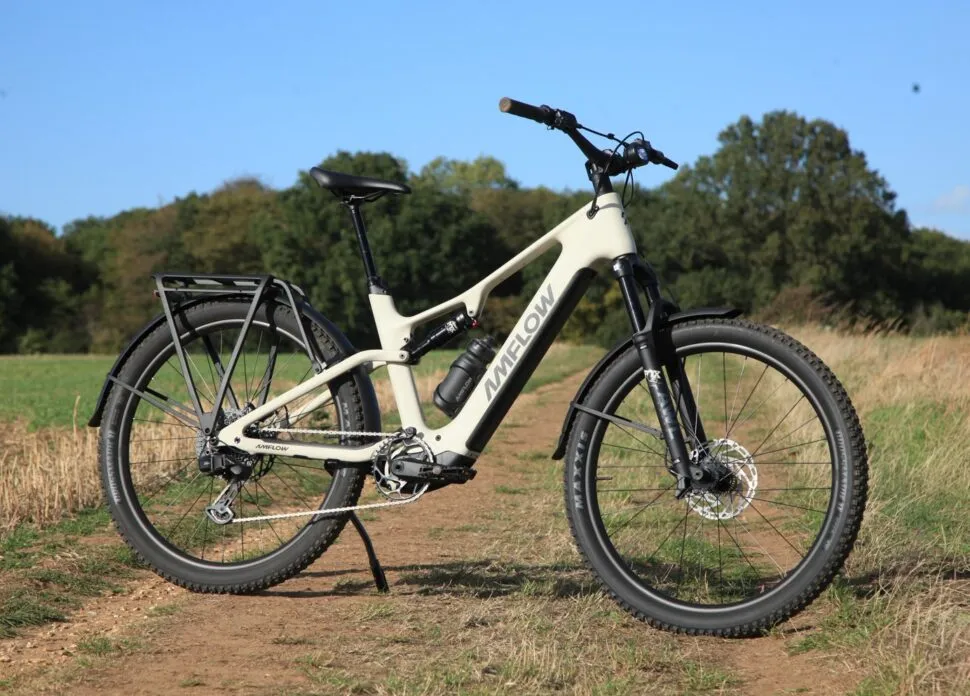
Brand new and set to debut in the second half of 2026 is the Amflow TL Carbon, the brand’s first departure from its core e-MTB starting point and one that sees it expand into long-distance touring.
With an up to 1,280Wh battery capacity by the time you have added a range extender, the Amflow TL is a shorter travel (120mm front/105mm) carbon fibre full suspension build that is optimised for covering ground. It does this with the support of sister brand Avinox, whose M2 motor is famously punchy with a 1,300W peak power applied when you need to tackle steep climbs. That makes this both incredibly appealing for the distance traveller, but also the mountain explorer, and it’s got an adjustable headset too if you do want to take a degree off the headtube angle and slacken the angles.
Perhaps the most astonishing thing about this electric touring bike is the price. Consider that this is a bike with a full carbon frame, with dual suspension, an incredibly capable motor, a massive battery capacity and brand name finishing kit, as well as electronic gear shifting. With all of that combined, the £3,199 price tag feels like unprecedented value in this space.
Orbea Muga 20


£4,769 (Range starts at £4,399)
Recently reviewed and coming in at a much more accessible price than the aforementioned Riese and Müller, Orbea’s new Muga platform is designed to be able to rip across countryside paths and down into town, with a pair of Schwalbe Johnny Watts tyres offering a balance of knurled grip and curved profile that glides on hard ground.
Though it’s well hidden, there’s a rear shock behind that joint in the middle of the frame and that gives this bike excellent versatility for the kind of terrain it’s happy taking on. During our test we were most often out in the woods, taking huge off-the-beaten-path shortcuts between towns, all the while carrying bags on that MIK rear rack, which hosts a generous 30kg.
One major perk of the Orbea Muga is that it can cover a lot of ground and still keep you comfortable. There’s a good length dropper seatpost that is remote actuated from the handlebar that lends agility to the rider, while the suspension pairing is a 120mm travel fork and 115mm rear shock.
This is as capable a bike after dark as it is during the day and integrated seamlessly into the handlebar is a good strength front light that is paired beneath by a 360-degree light wrap of the headset.
Catch our full Orbea Muga 20 review.
Specifications
Stated weight: Not stated
Stated range: Estimated 150km
Frame material: Aluminium 6061 hydrofromed
Motor: Bosch Performance Line CX
Battery: Bosch Powertube 750Wh (range extender compatible)
Drivetrain: Shimano Cues Di2
Brakes: Shimano MT420 hydraulic
Saddle: Selle Royal Vivo Ergo
Tyres: Schwalbe Johnny Watts
Suspension: Fox 34 AWL Sport fork / Fox Float Performance Trunion custom tune
Included accessories: Supernova TL3 rear and Starstream Pure front light, mudguards (metal), rear carrier (30kg ready), kickstand, Dropper seatpost (remote), SP Connect phone mount (Quad Lock optional).
Aventon Trava
£3,499 (EXP build) £2,500 (ADV build)
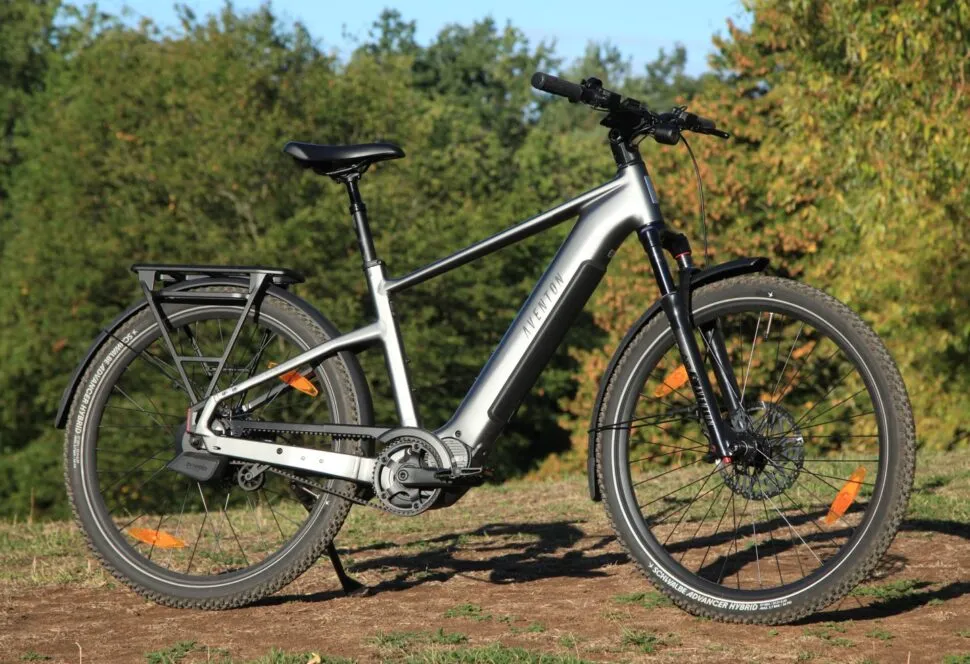
A brand that we’re taking a big interest in since its 2026 debut in the UK is Aventon, whose Trava EXP gave us a flavour of the high-value, high-performance package we may come to expect from the brand. Actually, despite rating the above Trava EXP very well in our review, our head was also turned by the lower-priced model, which, at a full £1,000 cheaper, still carries the same long-distance, high-capacity battery, making it an ideal electric bike for touring.
Still, if you want the perks of an internal gear hub and a belt drive, which is arguably better-suited to electric bike touring where a low-maintenance schedule is desirable, then the extra cash may be a worthwhile long-view investment. Certainly, the automatic gearing and Aventon motor work very well together and combine to be one of the most unbeatable electric bikes when it comes to climbing steep ascents.
We were particularly impressed with Aventon’s software and digital elements, with features including a strong anti-theft and geofencing package.
For touring, the 27 kg-capable rear rack is an essential, but as far as the accessories go, the wired-in lighting impressed us most, with the strong beam making riding after dark enjoyable.
Specifications
Stated weight: 28kg
Stated range: Up to 193km
Frame material: Aluminium
Motor: Aventon Ultro S
Battery: Aventon 800Wh, 36V
Drivetrain: Enviolo Trekking gearhub, 380% range
Brakes: Shimano MT200 hydraulic discs
Saddle: Aventon own brand
Tyres: Schwalbe Advanced Hybrid
Suspension: Aventon 100mm Air fork
Included accessories: Aventon pannier rack (27kg), wired-in lights, plastic mudguards, suspension seatpost, adjustable kickstand
Merida eBig Tour 675


£3,950 (RRP £4,250) | View offer
A well-priced hardtail option that can be sought out with a bit of discount attached is Merida’s eBIG Tour platform, a bike that we had on test earlier this year in its 675 EQ spec.
Something that may immediately appeal to a broad audience is the low step of the frame, falling somewhere between a true low-step and a traditional frame. This blends seamlessly with a powerful Shimano EP6 mid motor and a large 750Wh battery that, when combined, we estimate will deliver around 120km of assisted riding.
With a knurled tread but round profile, the Kenda Booster tyres clad to a 29er wheel cover both gravel path and tarmac ground efficiently. Ergonomic grips, a semi-upright geometry and a Suntour suspension fork pair to make sure you can make progress in comfort.
On the practical side, there is a rear rack specced as standard and into this a rear light is wired, which is the same story at the front of the bike. Mudguards and a kickstand are two more practical, standard features that mean the price is capped and you needn’t invest much more into accessories right away.
Catch our full Merida eBIG Tour 675 EQ review here.
Specs
Stated weight: ~25 kg
Stated range: Up to 120 km (Eco mode estimate)
Frame material: Alloy (Big.Tour aluminium)
Motor: Shimano EP6
Battery: Trendpower Internal Battery 750Wh
Drivetrain: SRAM PG-1210 Eagle
Brakes: SRAM DB8
Saddle: Merida Expert TK
Tyres: Kenda Booster
Suspension: XR Suntour XCR34 LOR DS
Included accessories: Front/rear racks, mudguards, integrated lights, kickstand
MMR E-woki

£1,899 | View offer
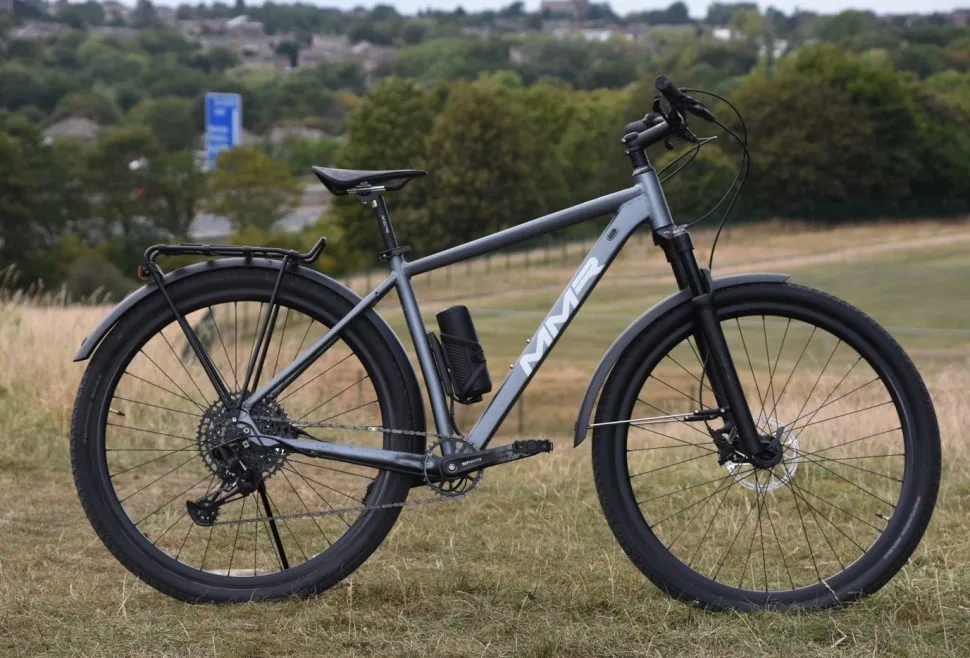
There are pros and cons to the MMR E-woki when it comes to using this electric bike for touring purposes and with its comparably small battery it’s perhaps not one to rely on for heavy mileage. However, it is incredibly keenly priced and has a super convenient charging system that involves a dock for the battery, so if you know you’ll have opportunity to stop occassionally and recharge then it’s a fine addition to this buyer’s guide.
What it gives up in battery capacity it gains in lowered weight, so it’s a sprightly ride and one that can happily be used with no pedal-assist for long periods on account of its 12-speed gearing and of the low rolling resistance of the Hutchinson tyres equipped.
If you have a budget of £2,000 and will be crossing counties instead of countries then this is a very reasonable package from a reputable Spanish manufacturer.
Read our full MMR Bikes E-woki review.
Specifications
Motor: Mahle EX30 rear hub motor
Battery: 171 Mahle eX1 171Wh, removable
Range: Estimated 15-50 miles, depending on how you use it
Weight: 19.8kg
Brakes: SRAM Level hydraulic discs
Saddle: Selle Italia Model X
Tyres: 28 x 2in (50 x 622mm) Hutchinson Republic
Suspension: Front steel sprung Suntour XCR 29
Frame material: Aluminium, four frame sizes
Gearing: SRAM SX 12V, 32T front chainring, largest rear cog 50T
Moustache J All


From £3,899 | VIEW OFFER (Automatic spec)
A very special electric bike in the Moustache Bikes catalogue comes in the form of the versatile ‘J’ platform and it’s three versions, spanning urban, semi-urban and full off-road capabilities.
The J All is, as you’d expect, the middle of the road offering that is built to cater for those who will be tackling a bit of everything. The frame of this smart full-suspension build is something special, as it is cast into that unique shape, optimising the layout with a two-piece construction and enabling the designers to get creative. This means low motor placement, a super clean chainline for the belt drive and an optimised overall weight.
There are various specs available in the J family, but this model has the super reliable Enviolo stepless gearing, which can be toggled even at standstill to make sure you’re never caught in to high a gear.
As far as long-distance electric bikes go, this one is among the most comfortable we have tried and it can be upgraded with a suspended luggage carrier that is MIK compatible and able to carry greater load.
Catch our full Moustache J All review.
Specification (based on model on test)
Frame: Aluminium (gravity cast)
Motor: Bosch Performance Line
Battery: 625Wh Bosch PowerTube internal (removable)
Range: Up to 90 miles
Weight: 29.6kg
Brakes: Magura hydraulic discs (listed as Alhonga HJ-472)
Gearing: Automatic Enviolo
Tyres: Schwalbe Johnny Watts 27.5 x 2.6
Suspension: SR Suntour XCR 34 Air Boost and Moustache Magic Grip shock
Optional extras: Light or suspended luggage carrier, Bosch PowerMore range extender
Frequently asked questions – Long-distance e-bike riding tips
What size battery should I be looking at to cover a weekend of countryside exploration?
Increasingly many electric bikes beyond a certain pricepoint are defaulting to large 800Wh batteries and these are brilliant for long-distance riding, though a little heavy. With this much battery capacity it’s viable to bank high mileage, even if you park your bike in an automatic mode, though to extend the range of the pedal assist we really do recommend turning down the assist while riding flat terrain in order to preserve your energy for more challenging points in the ride.
At a minimum, for this kind of riding and in particular if you are carrying luggage, we would recommend a 550Wh or above battery. Just keep in mind that the lower your battery capacity, the more sparingly you’ll have to ride.
How quickly can I recharge my touring electric bike’s battery?
This will depend on the charger. A 2A charger can take over five hours for a moderate-sized battery, but nowadays more electric bikes than ever are coming with a 4A charger, particularly at mid-tier prices. These can cut the charge time right down to three hours or so. Crucially, electric bike batteries tend to charge the first 80% at a higher speed and then deliver the final chunk at a slower pace, so quick top-ups are actually very effective if you get any opportunity to plug in even for half and hour. Lately we are starting to see 12A and even 30A chargers emerge at the high-end of the market and these will undoubtedly become more common at lower prices in time. A 30A charger can charge a 750Wh battery to 80% in only 15 minutes!
What features are particularly important on an electric touring bike?
What good is a touring bike without the ability to pack your camping gear and a picnic? With that said, a rear rack is a great start when assessing the features list, with things like rear wheel locks being a security bonus; though we obviously recommend a tough D-lock for high-value e-bikes. We have a guide to the electric bike accessories that we, as daily riders, swear by and that even includes things like remote power banks that can be taken on tours with you if you are combining cycling with a motorhome trip, for example. We use these for trailside top-ups if we are demanding a lot from a battery.
Perhaps the most important thing is to ensure you have the right bike for the job, inclusive of the right frame size and a riding position as tuned to perfection as is possible. Because you’ll be in the saddle for hours on end, even small adjustments to your positioning can add up to more energy retained. We recommend a more upright riding position for longer tours so that your back is straight and supported. You can adjust your reach to the handlebar with stem changes (or adjustments if possible), plus moving the seat back and forth on its rails.
Is rear suspension necessary for electric bike touring?
Not really, it depends on the terrain you expect to encounter and your skills. It won’t necessarily be more comfortable to have rear suspension as many touring hardtails are built explicitly with long-range comfort in mind and you could always seek out an electric bike with a suspension seatpost if you are after some lower back forgiveness when you take on a bumpy path. A hardtail will generally be more efficient at covering ground; however, a full-suspension electric bike will very often have a lockout functionality so that you can ‘lock’ the rear shock and have the bike ride as a hardtail would. Having that rear suspension available means you have greater versatility in the terrain challenges you can comfortably face. For mountain riding that strays into the woods, for example, rear suspension may be preferable.
How can I get the maximum range from my bike’s battery?
Some things that you can do to extend your range and make marginal range gains include making sure you have the right tyre pressure for the terrain, ensuring your brakes are not rubbing at all and that your drivetrain is functioning smoothly. You should be aware that in freezing temperatures, batteries tend to perform slightly worse on account of the chemistry inside the cells stiffening up. Here, a neoprene battery cover (if not internal), and indeed a warm and dry storage place overnight can keep your e-bike in its optimal state.
What factors most negatively affect electric bike range?
Rider weight and indeed the weight loaded onto the bike can have a big effect on electric bike battery life and your range. Things like wind direction can either help or hinder your progress, as can how smooth the terrain is under your wheels. If you have a lockout option on your suspension fork or rear shock, then using this on tarmac sections can improve the energy transfer of your efforts, thus supporting the bike’s efficiency. Overuse of the Turbo or highest assist mode will be the biggest single drain on the battery, so we recommend tuning your assist levels in a partner mobile application, if your bike allows, in order to optimise how you want your bike’s pedal assist to help you, or preserve its battery.
Why should you trust us? Cycling Electric is one of just a few fully human, in-person electric bike review publications based in the UK (though we cover European regulation models). We are actively involved in the bike industry and the political elements that govern this market. That means that we are only working with road-legal brands to deliver to you electric bike reviews from brands that you can trust. Our Editor has 20 years of experience with electric bikes and we commission freelance writers who are similarly experienced, including bike mechanics who can pick apart the technical quality of a product so that you can be sure you’re buying a bike that’s built to last.
If you wish to better understand the law around electric bikes, we have a guide; plus, if you have questions or do not fully grasp the jargon used here, then we have an e-bike FAQs to help.
link